

Japan Yearly Policy Review: Fiscal Year of 2025
Introduction
In Japan’s Fiscal Year 2025 (1 April 2025–31 March 2026), the Japanese government implemented economic and fiscal policies which will have long term implications on the direction of Japan’s steel industry and its decarbonisation efforts. This paper provides an overview and assessment on the direction of these policies and identifies opportunities to further align with global standards, in order to achieve both economic growth and decarbonisation, and to realise these objectives through a Green Transformation (GX).
Key Takeaways
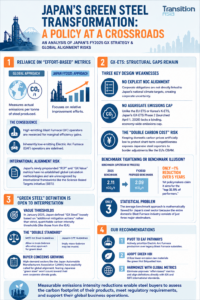
Japan’s GX decarbonisation strategy has progressed significantly in FY2025, reinforcing policy continuity despite a change in leadership. However, important shortcomings in policy design and implementation risk undermining its overall effectiveness. Key challenges include:
- GX Emissions Trading System (GX-ETS) design limitations: While the GX-ETS represents a key step in establishing carbon pricing, its lack of explicit alignment with Japan’s Nationally Determined Contributions (NDC) and the absence of a binding emissions cap weaken its ability to drive meaningful emissions reductions. Unclear benchmarks and relatively low domestic carbon prices further create policy uncertainty and expose exporters to potential double carbon costs.
- Ambiguous definition of “green steel”: The absence of quantifiable thresholds and inconsistencies with existing carbon accounting guidelines create uncertainty for both producers and buyers, limiting alignment with international standards and raising concerns over market acceptance.
- Reliance on “effort”-based metrics: Current policy emphasises indicators such as Reduced Emissions of Product (REP) and GX Value, prioritising relative improvements over absolute emissions intensity. While intended to support market development, these unproven approaches risk misalignment with global reporting frameworks and may constrain international credibility.
- Lack of clarity in investment strategy: Although the GX investment framework is ambitious, inconsistent production targets and the absence of quantified emissions reduction outcomes create uncertainty around its credibility and measurability.
- Risk of sidelining low-emission pathways: The framework may disadvantage already low-emission technologies, particularly electric arc furnace (EAF) production, by favouring transition-based metrics over actual emissions performance, potentially distorting incentives and weakening decarbonisation outcomes.
Decarbonisation Policy Remains Consistent Despite Leadership Change
In February 2025, the Japanese Cabinet approved the 7th Strategic Energy Plan (SEP), the Global Warming Countermeasures Plan (Japan’s NDC), and the GX2040 Vision. These policies informed subsequent discussions within working groups and deliberation councils, which ultimately defined green steel standards, transition finance guidelines, the GX-ETS framework, and strategies towards achieving industrial competitiveness and environmental commitments in FY2025.
In October 2025, Sanae Takaichi became Prime Minister of Japan and president of the Liberal Democratic Party (LDP) and in February 2026, her administration won a landslide victory in a snap election. Despite changes such as a pause in mega-solar and restarting nuclear facilities, the majority of decarbonisation policies focused on simultaneous emissions reduction and economic growth, including those established by previous LDP administrations such as Abe, Kishida and Suga, will continue as planned.1
1. GX-ETS Not Aligned Explicitly with NDC, Risking Missed Emissions Targets
The first phase (2023–March 2026) of the GX-ETS was a voluntary scheme for GX League companies to set emissions reduction targets, and begin calculating and reporting emissions. The second phase of the GX-ETS was launched on 1 April 2026, marking the start of FY 2026.
Under the scheme, all emitters, including blast furnace (BF) steelmakers, with Scope 1 emission exceeding 100,000t of CO2 are required to take part in the scheme, covering approximately 60% of Japan’s total emissions. Entities that exceed their allocated emissions allowances must purchase additional quotas, while some allowances will be allocated by the government for free. Payment for carbon cost will be required from FY2027.
The benchmarks used to determine the emission quota level vary across industries and production processes, and are still under development. According to current government disclosure, the benchmarks applied to steelmakers are expected to be set at 2.09 tCO2/t (-0.95% from 2.11 tCO2/t in 2025) for the upstream process in the BF pathways and 0.064 t-CO2e/t (-12.3% from 0.073 t-CO2e/t in 2025) in its downstream process over a five-year period to 2030.2 3
The key question is whether the GX-ETS and the benchmarks currently under discussion will lead to real decarbonisation. By not explicitly aligning with the NDC, Japan’s climate commitment plan, it is difficult for corporations to quantify the amount they must contribute to achieve emissions reduction in line with the national target. 4 5 6
1.1 Risks of double payment and risking long-term competitiveness
Unlike the EU-ETS and the K-ETS in Korea, the GX-ETS has not yet set an aggregate emissions cap for participating companies, thereby weakening incentives for emissions reduction. Some argue that stringent regulations could harm the competitiveness of Japanese businesses and industries. While this concern is partly valid in the short term due to higher costs, the longer-term impact should also be considered, as the GX Economy Transition Bonds redeemed by funds emitters pay are intended to support investment and industrial transition. In addition to a smaller amount of payment for carbon, maintaining lower domestic carbon prices does not inherently enhance competitiveness; rather, it increases the risk of “carbon leakage” costs abroad. If Japanese carbon prices remain significantly below global benchmarks, exporters face the risk of double taxation by paying a low domestic price and then being subjected to border adjustments, such as the EU’s Carbon Border Adjustment Mechanism (CBAM), in foreign jurisdictions.Transition Asia has examined the cost and impacts of the GX ETS on Japan’s steel industry. Key recommendations include prioritisation of the electric arc furnace (EAF) pathways, utilising lower-emission raw materials such as green hot briquetted iron (HBI), and decarbonising energy sources through more RE procurement.7
Compliance with the EU ETS and CBAM will depend on Japanese domestic policy pathways, especially for steel exports, given the European Commission’s intent to extend CBAM to include downstream finished goods.
1.2 Questionable Benchmark Design Based on a Limited Set of BF Steelmakers
The GX-ETS employs a benchmark approach to define the level of required emission reductions for the BF assets. Benchmarks are initially expected to be set based on the top 50% performers in each industry and tighten to the top 32.5% by FY2030. In practice, this would reduce the upstream emissions intensity of BF–BOF steelmaking from 2.11 tCO2/t to 2.09 tCO2/t, equivalent to around a 1% reduction over five years.8 9 However, Japan has only three BF steelmakers, calling into question the rationale and effectiveness of an average benchmark approach for the steel industry, and available disclosure does not present a clear rationale for this framework.
These design gaps undermine the effectiveness of the GX-ETS as a core decarbonisation instrument. Strengthening the alignment between the GX-ETS and Japan’s NDC would enhance both policy robustness and international credibility, and also provide corporations with clearer and more predictable signals on carbon costs and required emissions reductions. While higher carbon pricing may pose short-term risks to Japan’s competitiveness, it could help limit the outflow of carbon-related payments to competing foreign jurisdictions, and allow revenues to be retained and reinvested in domestic industry.
2. Japan’s definition of GX Steel remains open to interpretation
Japanese policymakers have acknowledged the need to have global alignment in standards and definitions to maintain competitiveness, but the current guidelines and definitions for “GX Steel” remain unclear.
The Study Group on Green Steel for Green Transformation (hereinafter referred to as the Study Group) was established under the Ministry of Economy, Trade and Industry (METI) in 2024, with the prime objective to determine future policy direction while addressing information dissemination and market expansion challenges.10 11
In January 2025, the Study Group defined “green steel” as “steel products that have a significant environmentally favourable impact due to additional direct emission mitigation actions on a company-by-company basis. These products also experience a significant price increase compared to general products when the costs associated with these actions are included” (hereinafter referred to as the “green steel” or “GX Steel”). 12
The main concern is that the definition lacks a quantifiable threshold and is therefore open to interpretation. Without clear metrics or criteria, such as the use of the definition and thresholds provided by the International Energy Agency (IEA), a definition is less likely to be recognised as aligned with global standards.13 14 15 Voices from steel demand sectors have expressed concern over whether procuring GX Steel will align with their own corporate emissions reduction commitments, because of current misalignment with global standards such as Science Based Target Initiative (SBTi). For example, Japan Automobile Manufacturers Association (JAMA) had already raised their concerns in the Study Group’s third discussion in 2024, clearly stating that JAMA is calling for alignment with standards recognised globally.16
Further uncertainty arises from inconsistencies in methodology. METI and the Ministry of Environment (MoE) have positioned GX Steel as Japan’s primary domestic benchmark, yet its acceptance of a mass-balance and allocation approaches remain misaligned with Carbon Footprint (CFP) guidelines developed by the same ministries, now in force, which imply that mass-balance may not be acceptable. This discrepancy creates uncertainty for both steelmakers and buyers regarding a product’s emissions reduction validity. It is essential that the government resolve this “double standard” to ensure a unified national framework that is recognised globally in the upcoming CFP guideline revision.
Although efforts to develop a definition is positive, there is further opportunity to align with global definitions to provide confidence to buyers and investors. Therefore, to prevent buyer confusion and ensure global alignment, Japan could harmonise domestic GX Steel definition with international benchmarks, which would in turn benefit domestic industry.17
3.Current policy prioritises “effort”-based metrics over absolute emissions intensity reductions
In April 2025, the Study Group reviewed green steel initiatives, focusing on LCA methods, market development, and global standards such as the SBTi. The discussions indicate a policy focus on market creation and ecosystem development rather than absolute emissions reductions.
The key takeaways from the Study Group were: first, a framework is needed to effectively communicate and demonstrate the value of products using green steel to the demand side across the entire value chain; and second, expanding the market for green steel to promote GX is vital. These discussions represent a positive step, signalling a commitment to strengthening domestic supply‑and‑demand value chains while reinforcing global coordination. However, the basis for the current discussion uses “effort” as a measure of product value, and the market creation methods being proposed favour BF steelmakers over inherently lower-emission EAF steelmakers.
3.1 “GX Value” and REP reward emission reduction efforts
Introduced by METI in mid-2025, “GX Value” integrates a product’s economic competitiveness with its environmental impact.18 By incorporating Reduced Emissions of Product (REP), the framework enables companies to “visualise” the added value of low-emission goods. This allows functionally identical products to be differentiated based on reduction efforts that fall outside traditional carbon footprint calculations.19
Although the REP framework has been proposed and defined by METI working groups as an indicator for corporate emission reductions, it lacks established calculation methodologies and is not recognised or adopted globally as of today. An official document acknowledged that REP is a new concept which was “propounded” by an advisory panel.20 Despite objectives to publish guidelines by the end of the fiscal year of 2025 to ensure international substantiation, no official guidance has been released to date.21
METI documents argue that traditional CFP metrics fail to communicate the “mitigation efforts” of high-emission producers. Under this reasoning, conventional BF steelmakers are viewed as being at a structural disadvantage compared to inherently lower-emission EAFs. This forms the basis for the “GX Steel” methodology, which utilises REP and allocated-based CFP methods to address this perceived gap.22
This framework prioritises comparative indicators, quantifying “effort” relative to conventional products, over absolute reduction metrics. By emphasising relative value rather than total carbon output, it may create discrepancies with international standards that prioritise absolute decarbonisation, as it can obscure actual emissions reductions.
Currently, there is a risk that using REP to indicate environmental value will be rejected globally. Organisations such as the World Resources Institute (WRI) and the GHG Protocol categorise such metrics as “comparative emissions” rather than absolute reductions.23 While the concept of “Avoided Emissions” (AE) was noted in the 2023 G7 Communiqué under Japan’s presidency, REP remains a distinct and unproven methodology with no track record of international acceptance.24 Consequently, downstream companies procuring “GX Steel” may be unable to use these figures for Scope 3 reporting or formal climate claims, undermining the product’s intended market value.
3.2 Misalignment with Global Standards and Reporting Frameworks
Starting in 2028, a new “Building Life Cycle Assessment” system will begin, to increase the disclosure of upfront and embodied carbon in the Japanese construction sector. While this move should theoretically drive demand for low-carbon materials, “GX Steel” ambiguity remains a challenge: steelmakers must provide intensity data for these products, but the underlying methodology remains ambiguous compared to global LCA standards.
An interim report from February 2026 identifies the evaluation of GX Value, through REP and AE, as an important incentive for decarbonising construction materials.25 The report promotes early adoption through green procurement and labelling but acknowledges that the treatment of these metrics remains unclear under mandatory disclosure frameworks like the SSBJ and GHG Protocol, creating confusion for the construction and real estate industry. For the steel sector, JISF has already operationalised these concepts with the “GX Steel Guideline”, which uses Allocated and Residual CFP.26 27 In February 2026, MoE revised the “principle” of the Act on Promoting Green Procurement, advising institutions to prioritise selecting products with lower GHG emissions, based on calculation methods in the “Carbon Footprint Guidelines” formulated by METI and MoE. The directive encourages the use of primary data to the extent possible in order to reduce emissions across the entire supply chain. A neutral reading of this suggests evaluations should be based on absolute emissions.28 29
Although guidelines are not officially determined or legally established yet, the Sectoral Investment Strategy emphasises the critical importance of creating demand for “green iron” and “green steel”, stipulating that their application should be actively expanded not only in public procurement but also across public works projects. The GX2040 Vision also encourages the public sector to create a market for GX products. The purpose of this policy is to create initial demand for new, greener products but risks a scenario where public procurement uses a disparate concept wherein comparative emissions reduction is used during procurement valuations domestically, while absolute emission values are used for global standard compliance. This misalignment poses long-term risks on reporting and credibility of Japanese “green” products in foreign markets.30
In March 2026, MoE revised the Environmental Labelling Guideline, establishing a framework for verifiable and accurate disclosures.31 By explicitly linking environmental transparency to international competitiveness in an official document, the government has acknowledged that data integrity is now a core economic asset. The guidelines also warn of intensified global scrutiny of corporate disclosures and note that misleading environmental claims may constitute a business risk, including potential fines from international authorities.32
This development is significant. However, it also underscores a potential credibility gap for the Japanese steel industry’s investment in the “GX” brand, given its reliance on comparative metrics. Under the new guidelines, methodologies based on “relative effort” rather than absolute emission transparency risk being categorised as greenwashing, potentially undermining the international competitiveness of Japanese products. In this sense, the MoE’s guideline can be interpreted as implicitly questioning the government’s current definition of “green steel”.33 34 35 36
4.Japan’s GX Investment Strategy Would Benefit from Greater Clarity and Consistency
In FY2025–2026, Japan revised key policies on the investment framework and roadmap for sectoral decarbonisation. While the overall direction is strategically aligned, important gaps remain that risk undermining market confidence—particularly in relation to the clarity of production targets and the transparency of emissions reduction outcomes.
Further details on (I) the public–private investment roadmap and (II) the investment strategy are provided in the Appendix.
At a high level, the revised framework establishes a large-scale public–private investment programme to support GX-related decarbonisation and economic growth, with the steel sector identified as a major beneficiary. It sets out ambitions to scale up low-emissions steel production, accelerate the deployment of EAF, DRI and hydrogen-based technologies, and support market creation alongside capital investment. The roadmap also positions “green steel” as a strategic priority linked to economic security and global competitiveness, while identifying constraints such as the supply of high-grade scrap.
The overarching frameworks of these three seem fair. However, it is observed that there are two points that should be presented through a clarification.
First, there is a lack of clarity in production targets. While the investment strategy and roadmap reference
a 10 million tonne target, the technology roadmap indicates a significantly lower figure of 3 million tonnes. The rationale for this discrepancy is not explained in available disclosures, creating uncertainty for stakeholders. Whether this reflects differences between production capacity and actual output, or revised assumptions on demand or technology deployment, should be clearly articulated.37
Second, the framework lacks transparency on emissions reduction outcomes and green steel definition. Another critical issue is that the steel section of the Strategy does not include any quantified estimates of emissions reduction.While it explicitly aims for a green steel market of approximately 3 million tonnes in the first half of the 2030’s both domestically and globally, the issue of the ambiguous green steel definition remains. Without quantifying this essential value, it is impossible to verify if this amount and these Japanese labelled “green”products can be recognised globally, and whether Japanese steel can truly capture this market, or if the target is anything more than an aspiration. Although the Strategy itself is designed primarily for Japan’s economic growth, the global trend is moving towards mandatory GHG reporting and carbon regulations, necessitating a discussion on how to achieve environmental commitments.38
5. EAF-based low-emission steel risks being sidelined in the GX framework
The government’s evolving definition of “green steel”, intended to be formalised through a standardised framework, raises questions about scope and inclusivity. The GX Steel methodology prioritises transition-based “effort” metrics, such as REP and allocation-based approaches, over steel products that have already achieved low emissions intensity, particularly those produced via EAFs. This risks excluding existing low-emission pathways from the policy definition.
It remains unclear whether all low-emission steel is intended to be included in policy packages such as financial support that BF steelmakers enjoy, or whether factors such as steel grade or quality are being used to justify exclusion. There is limited public evidence of a transparent assessment showing that existing low-emission steel cannot meet required standards, raising concerns about accountability.
This lack of clarity has practical implications. EAF-based steel may be disadvantaged in public procurement, financial support, and market recognition, with its decarbonisation value potentially undervalued in both domestic and international markets. It is also unclear whether these risks have been formally assessed or whether safeguards are in place. Without greater transparency, the framework risks distorting incentives and undermining both credibility and decarbonisation outcomes.
6. Conclusion
As discussed throughout this review, the overarching policy direction is fundamentally sound in its pursuit of decarbonisation compatible with national economic growth. However, the persistent question remains whether the individual policy instruments are sufficiently well-designed to achieve this dual mandate. Aligning decarbonisation with national interest is an immense challenge, yet it remains the essential target. To reach this goal, Japan requires more elaborate policy designs based on a comprehensive evaluation of the needs across the supply side, the demand side, and end-users. Looking ahead to FY2026, Japanese policy makers must strengthen policy coherence and credibility to ensure that the steel sector can meet climate targets without compromising its international competitiveness.
Appendix
I. Revisions to the Technology Roadmap for Steel Regarding the Transition Finance
Towards the end of fiscal year 2025, a revision of the roadmap was released.39 This document outlines a roadmap of domestic and international technologies and a strategic pathway toward 2050, with an emphasis on the transition requiring not only the replacement of energy-saving equipment but also the effective utilisation of existing infrastructure, and the implementation of innovative decarbonisation technologies and the procurement of substantial capital.
Developed through deliberations between academic experts, financial specialists, and industry representatives, the roadmap aims to enhance the international competitiveness of the Japanese steel industry while remaining consistent with the Basic Guidelines on Climate Transition Finance.40 41 It serves as a comprehensive reference for Japanese steel companies pursuing climate change countermeasures and assists financial institutions, including banks, securities firms, and investors in evaluating the eligibility of decarbonisation initiatives for transition finance. With the ultimate objective of achieving carbon neutrality by 2050, this roadmap also provides a conceptual framework for low-carbon and decarbonisation technologies expected to be commercialised by mid-century, as well as their projected timelines for implementation, based on currently available information. This roadmap maintains consistency with the NDC established under the Paris Agreement, the Green Growth Strategy, the Research, Development and Social Implementation Plans of the Green Innovation Fund, and the 7th Strategic Energy Plan. At present, the technologies required to achieve carbon neutrality in the steel sector have not yet been fully established but the roadmap stresses that R&D for unproven technologies is indispensable, necessitating a concerted, integrated public-private effort toward 2050.42 With the core content largely unchanged from previous versions, the roadmap focuses mostly on the 2050 Carbon Neutrality goal. Consequently, specific pathways or detailed targets for 2030 or 2040 are not covered in this document.43 44
II. Strategy on Sector-by-Sector Investments
In December 2025, METI revised the Strategy on Sector-by-Sector Investments, which establishes a JPY 150 trillion public-private sector investment framework. The strategy funds GX initiatives for decarbonisation and economic growth through the issuance of government bonds, which then use revenue for the GX-ETS scheme as repayment mechanism.45 Under this framework, the steel industry is a key beneficiary, receiving over JPY 3 trillion in combined investments to achieve a 2030 production target of 10 million tonnes of “green steel” through three core focuses: 1) Implementing decarbonisation through the replacement of BF with large-scale EAF; 2) Expanding the output of high-quality steel from larger EAFs and DRI; and 3) Accelerating the development and installation of Hydrogen-DRI (H2DRI) ironmaking to achieve mass production ahead of global competitors.46
This 10-year, public-private JPY 3 trillion investment expects to decarbonise up to 30 million tonnes, which is around 2.87% of Japan’s total 2024 carbon emissions (1.046 billion tonnes).47
III. Public–private investment roadmap
In March 2026, the draft Public-Private Investment Roadmap was released, identifying “green steel” as one of 17 key priority areas for national policy support.48 The inclusion of this in Prime Minister Takaichi’s roadmap for “crisis-management” and “growth investment” acknowledges how the global shift towards decarbonisation plays a role in Japan’s economic security.49 50 51 52
The framework recognises decarbonisation technologies currently being deployed by global competitors, the vast economic potential of the green steel market, and Japan’s unique capacity to produce high-quality steel from scrap and DRI. It identifies critical areas for government intervention, specifically providing support for capital expenditure (CAPEX) in process conversion and stimulating market demand. This summary serves as a foundational framework for policies aimed at accelerating the steel industry’s decarbonisation and is key to securing Japan’s position in global competition. Notably, the strategy explicitly identifies the stable supply of high-grade scrap as a primary challenge and enhanced recycling systems as a desirable measure.53 Together, these elements reflect a strategic alignment between domestic policy and global market trends.
IV. Revision of the GI Fund
Revision to the GI Fund In March 2026, the maximum R&D budget for certain hydrogen-based steelmaking projects—specifically “Development of high-efficiency melting technologies by an electric smelting furnace using directly reduced iron”—was reduced from JPY 23.0 billion (USD 147 million) to JPY 12.26 billion (USD 77.1 million).54 In addition, the planned size of the pilot furnace was scaled down significantly, from around one-fifth of a commercial-scale unit to approximately one-sixty-fifth. While this adjustment is described as a shift towards a smaller-scale furnace to enable more detailed process analysis, rather than a change in the overall project objectives, it will be important to continue monitoring whether the programme progresses as originally intended.55
| Original Plan | Revised Plan | |
| R&D Budget | JPY 23 billion (USD 147 million) | JPY 12.26 billion (USD 77.1 million) |
| Size compared to a commercial-scale unit | 1/5th | 1/65th |
Source: METI56
V. FY2026 initial budget proposal
There are no major changes overall. However, substantial financial support has been maintained for industrial electrification and the transition of steelmaking processes, with subsidies amounting to JPY 48.5 billion (USD 305 million).57 58 This represents a positive development, particularly compared with the FY2025 budget allocation of JPY 25.6 billion (USD 161 million).59
VI. Energy and Manufacturing Process Transformation Support Business (Business I (Steel))
A. On 9 April 2025, JFE Steel was awarded government support for the introduction of a large-scale, next-generationEAF at its Kurashiki facility, with an annual production capacity of approximately 2 million tonnes.60 61 Of the total investment of JPY 329.4 billion (USD 20.7 billion), up to around
JPY 104.5 billion (USD 657.5 million) which approximately equates to one third, will be covered by subsidies.
B. On 30 May 2025, Nippon Steel was granted support for a programme to expand three EAF facilities, with a total investment of JPY 868.7 billion.62 63 This includes the construction of a new EAF at the Yawata area, the addition of one EAF at the Hirohata area, and the modification and restart of an EAF at the Shunan area. Government support for these investments will amount to up to JPY 251.4 billion (USD 1.58 billion).
| JFE | Nippon Steel | |
| Annual Production Capacity | 2 Mt | Yawata: 2Mt
Hirohata: 0.5 Mt Shunan: 0.4 Mt |
| Total Investment | JPY 329.4 billion (USD 20.7 billion) | Yawata: JPY 630.2 billion (USD 3.96 billion)
Hirohata: JPY 140.0 billion (USD 881 million) Shunan: JPY 98.5 billion (USD 620 million) |
| Government Support | JPY 104.5 billion (USD 657.5 million) | Yawata: JPY 179.9 billion (USD 1.13 billion)
Hirohata: JPY 42.8 billion (USD 269.3 million) Shunan: JPY 28.7 billion (USD 181 million) |
Source: Company websites, JFE64 and Nippon Steel65
VII. GX Strategic Zones
Within this framework, the “decarbonised power-based regional contribution“ support package (aimed at business operators) is designed to provide capital investment support to manufacturers that utilise decarbonised electricity. Under this scheme, up to 50% of capital expenditure—such as building costs and machinery—may be subsidised, provided that certain conditions are met. These include:
A. Undertaking investment above a specified scale, and demonstrating that the project is of high quality from both industrial and energy policy perspectives
B. Producing high value-added products and contributing to the strengthening of industrial competitiveness
C. Using 100% decarbonised electricity, while also contributing to the local municipality or prefecture where the power source is located
End Notes
- https://www.meti.go.jp/press/2025/03/20260319004/20260319004.html
- https://www.meti.go.jp/shingikai/sankoshin/sangyo_gijutsu/emissions_trading/pdf/004_03_00.pdf
- https://www.meti.go.jp/shingikai/sankoshin/sangyo_gijutsu/emissions_trading/benchmark_wg/pdf/005_09_00.pdf; Notably, the preamble of this ‘Opinion’ calls for the Minister of METI to establish guidelines for the allocation of emission allowances for Decarbonisation Growth-Oriented Investment Participants; this is believed to have significantly influenced the design of the GX-ETS.
- https://www.cas.go.jp/jp/seisaku/gx_jikkou_kaigi/pdf/kihon_en.pdf
- https://www.enecho.meti.go.jp/en/category/special/article/detail_179.html
- https://www8.cao.go.jp/kisei-kaikaku/kisei/conference/energy/20231225/231225energy04.pdf
- https://transitionasia.org/japans-green-steel-transition/
- https://www.meti.go.jp/shingikai/sankoshin/sangyo_gijutsu/emissions_trading/pdf/004_03_00.pdf
- https://www.meti.go.jp/shingikai/sankoshin/sangyo_gijutsu/emissions_trading/benchmark_wg/pdf/005_09_00.pdf
- https://www.meti.go.jp/shingikai/mono_info_service/green_steel/index.html
- https://www.meti.go.jp/shingikai/mono_info_service/green_steel/pdf/001_03_01.pdf
- In this paper, the terms “green steel” (as used by the Japanese government) and “GX steel” (as used by the Japan Iron and Steel Federation, JISF) are used interchangeably for analytical purposes. While these terms originate from different institutional contexts and are not formally identical, they broadly refer to steel products associated with decarbonisation efforts, rather than absolute emissions. Any differences in terminology or definition do not materially affect the analysis presented.
- https://www.meti.go.jp/shingikai/mono_info_service/green_steel/pdf/20250123_2.pdf
- https://www.meti.go.jp/english/press/2025/pdf/0123_001a.pdf
- https://www.enecho.meti.go.jp/about/special/johoteikyo/green_steel_01.html; As for this IEA’s definition, the Japanese Government itself acknowledged through stating that ‘While further discussion is needed on this matter, it will undoubtedly serve as a starting point in defining green steel’.
- https://www.meti.go.jp/shingikai/mono_info_service/green_steel/pdf/003_06_00.pdf
- https://iea.blob.core.windows.net/assets/0910c4ff-4008-48f5-a3ec-c52996ed694d/Definitionsfornear-zeroandlow-emissionssteelandcementandunderlyingemissionsmeasurementmethodologies.pdf
- https://www.meti.go.jp/shingikai/energy_environment/gx_carbon_footprint/index.html
- https://www.meti.go.jp/shingikai/energy_environment/gx_carbon_footprint/pdf/20250627_1.pdf
- https://www.meti.go.jp/shingikai/energy_environment/gx_product/pdf/20240326_1.pdf
- https://www.cas.go.jp/jp/seisaku/gx_jikkou_kaigi/senmonka_wg/dai12/shiryo.pdf
- https://www.meti.go.jp/shingikai/energy_environment/gx_carbon_footprint/pdf/20250627_1.pdf
- https://ghgprotocol.org/sites/default/files/2023-03/18_WP_Comparative-Emissions_final.pdf
- https://www.meti.go.jp/press/2023/04/20230417004/20230417004-1.pdf
- https://www.cas.go.jp/jp/seisaku/building_lifecycle/dai3/gijishidai.html
- https://www.cas.go.jp/jp/seisaku/building_lifecycle/dai2/siryou1.pdf
- https://www.cas.go.jp/jp/seisaku/building_lifecycle/dai3/shiryo1.pdf
- https://www.env.go.jp/press/press_02550.html
- https://www.env.go.jp/content/000387322.pdf
- https://www.env.go.jp/content/000387322.pdf
- https://www.env.go.jp/policy/hozen/green/g-law/net/page_00094.html
- https://www.env.go.jp/content/000390026.pdf
- https://www.theclimategroup.org/our-work/news/steel-industry-needs-consistent-reporting-standards-achieve-real-emissions-cuts
-
https://steelwatch.org/press-releases/civil-society-organisations-urge-rejection-of-deceptive-accounting-schemes-in-steel-standards/; Here more than 30 organisation including centres of excellence from all over the globe, Europe, Africa, Asia, Australia, North America and South America, signed on the letter.
- https://www.econetworks.jp/internatenw/2026/02/massbalance/
-
https://www.meti.go.jp/shingikai/mono_info_service/green_steel/pdf/003_03_00.pdf; A METI advisory body also has previously flagged the risk of these approaches being perceived as greenwashing. Notably, some suppliers include disclaimers suggesting that interpretations of these referenced standards remain subject to change.
- https://www.meti.go.jp/shingikai/energy_environment/transition_finance_suishin/pdf/014_03_00.pdf
- https://www.cas.go.jp/jp/seisaku/nipponseichosenryaku/kaigi/dai3/shiryou2.pdf
- https://www.meti.go.jp/shingikai/energy_environment/transition_finance_suishin/pdf/014_04_00.pdf
- https://www.meti.go.jp/policy/energy_environment/global_warming/basic_guidelines_on_climate_transition_finance.pdf
- https://www.meti.go.jp/policy/energy_environment/global_warming/transition/basic_guidelines_on_climate_transition_finance_jpn_2025.pdf
- https://www.meti.go.jp/shingikai/energy_environment/transition_finance_suishin/pdf/014_04_00.pdf
- https://www.meti.go.jp/policy/energy_environment/global_warming/transition/transition_finance_technology_roadmap_iron_and_steel_jpn.pdf
- https://www.meti.go.jp/shingikai/energy_environment/transition_finance_suishin/pdf/014_04_00.pdf
- https://www.meti.go.jp/press/2025/12/20251226003/20251226003.html
- https://www.meti.go.jp/press/2025/12/20251226003/20251226003-1.pdf
-
https://www.env.go.jp/content/000392897.pdf: This equates to 3.02% in the net carbon emissions considering the carbon sequestration.
- https://www.cas.go.jp/jp/seisaku/nipponseichosenryaku/kaigi/dai3/shiryou2.pdf
- https://japan.kantei.go.jp/104/actions/202511/10seichyou.html
- https://www.cas.go.jp/jp/seisaku/nipponseichosenryaku/kaigi/dai1/shiryou4.pdf
- https://www.cas.go.jp/jp/seisaku/nipponseichosenryaku/kaigi/dai3/shiryou2.pdf
- https://www.cas.go.jp/jp/seisaku/nipponseichosenryaku/kaigi/dai3/shiryou1.pdf
- https://www.cas.go.jp/jp/seisaku/nipponseichosenryaku/kaigi/dai3/shiryou2.pdf
- https://www.meti.go.jp/policy/energy_environment/global_warming/gifund/gif_05_randd_3r.pdf
- https://public-comment.e-gov.go.jp/pcm/download?seqNo=0000308526
- https://www.meti.go.jp/policy/energy_environment/global_warming/gifund/gif_05_randd_3r.pdf
- https://www.meti.go.jp/main/yosangaisan/fy2026/pr/gx.html
- https://www.meti.go.jp/main/yosangaisan/fy2026/pr/pdf/pr_gx.pdf
- https://www.mof.go.jp/policy/budget/budger_workflow/budget/fy2025/seifuan2025/08.pdf
- https://www.jfe-steel.co.jp/en/release/2025/04/250410.html
- https://www.jfe-steel.co.jp/release/2025/04/250410-1.html
- https://www.nipponsteel.com/en/newsroom/news/2025/__icsFiles/afieldfile/2025/09/26/20250530_200.pdf
- https://www.nipponsteel.com/common/secure/news/20250530_200.pdf
- https://www.jfe-steel.co.jp/en/release/2025/04/250410.html
- https://www.nipponsteel.com/en/newsroom/news/2025/__icsFiles/afieldfile/2025/09/26/20250530_200.pdf
- https://www.cas.go.jp/jp/seisaku/gx_jikkou_kaigi/sangyoritchi_wg/pdf/summary.pdf
Data and Disclaimer
This analysis is for informational purposes only and does not constitute investment advice, and should not be relied upon to make any investment decision. The briefing represents the authors’ views and interpretations of publicly available information. The authors and Transition Asia expressly assume no liability for information used or published by third parties with reference to this report.