

Press Release – The World’s Largest Greenfield Steel Project Could Cut Green Steel Premiums to Just 6-13%
New analysis finds the remaining gap is decided outside the plant: by power contracts, hydrogen supply, and how India’s carbon market evolves
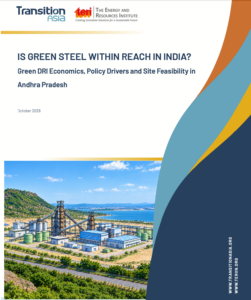
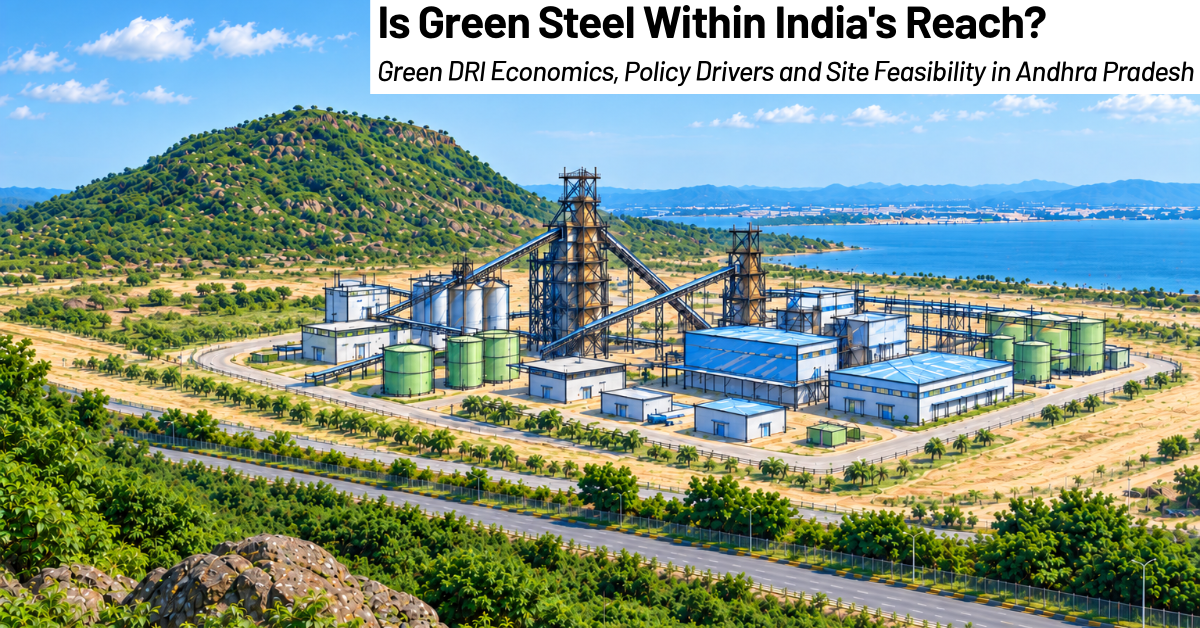
Transition Asia and The Energy and Resources Institute today jointly published Is Green Steel Within Reach in India? Green DRI Economics, Policy Drivers and Site Feasibility in Andhra Pradesh. The report assesses the economics of green steel at the planned 17.8 million-tonne-per-annum steel complex in Rajayyapeta, Andhra Pradesh. Owned by ArcelorMittal Nippon Steel (AM/NS) India, the complex is the world’s largest ever greenfield steel project.
Phase 1 of the project, with 8.2 Mtpa of production capacity, is committed to conventional coal-based steelmaking and is expected to begin production in 2029. Phase 2, about 9.6 Mtpa scheduled for commissioning in 2033, has not yet been assigned a production route, leaving the door open to a lower-emissions technology choice. The report evaluates three direct reduced iron (DRI) technologies for Phase 2, the shaft furnace, the fluidised bed and the rotary kiln, against the conventional coal-based blast furnace route (BF-BOF). It assesses what each costs and emits, how mature each technology is and which iron ore it can use, and how the answer depends on green hydrogen availability, power procurement, and carbon pricing in India and at the EU border.
The Phase 2 Decision Could Shape India’s Green Steel Future
India now accounts for 42% of all steelmaking capacity under development worldwide, with 357 Mtpa in the pipeline, three times that of China. However, most of this capacity has yet to be built, meaning the technology choices made now will shape both the sector’s emissions trajectory and the economics of India’s steel expansion for many decades.
The Phase 2 decision at Rajayyapeta is therefore a test case for the wider Indian steel sector. It will show whether lower-emissions steelmaking can make commercial sense for new capacity and, by extension, whether the same investment logic could apply across the country’s broader project pipeline.
The cost gap is no longer the main barrier to green steel
Green steel at this site is not blocked by technology, and policy and commercial arrangements have the opportunity to close the remaining cost gap.
When run on 100% green hydrogen, the three direct-reduction routes modelled make steel for US$571–606 (₹49,800–52,800) per tonne, against US$536 (₹46,700) per tonne for the conventional coal-based blast furnace route. That is a premium of 6–13% with India’s notified hydrogen support. Emissions fall from 2.6 tonnes of CO₂ per tonne of steel to 0.3–0.6 tonnes. The three routes sit within US$35 (₹3,100) of one another, so the direct reduction reactor is chosen on iron-ore supply, technical maturity and emissions rather than on headline cost. The same reactors can also run on natural gas, at a cost close to coal-based steel. However, given the risk of depending entirely on imported LNG, hydrogen should be designed into the plant from the first day.
Even without a carbon cost, this is a much narrower gap than the market often assumes. Green steel does not require a major technology breakthrough to become competitive. It requires the right policy and contracting environment to close a relatively small remaining cost gap.
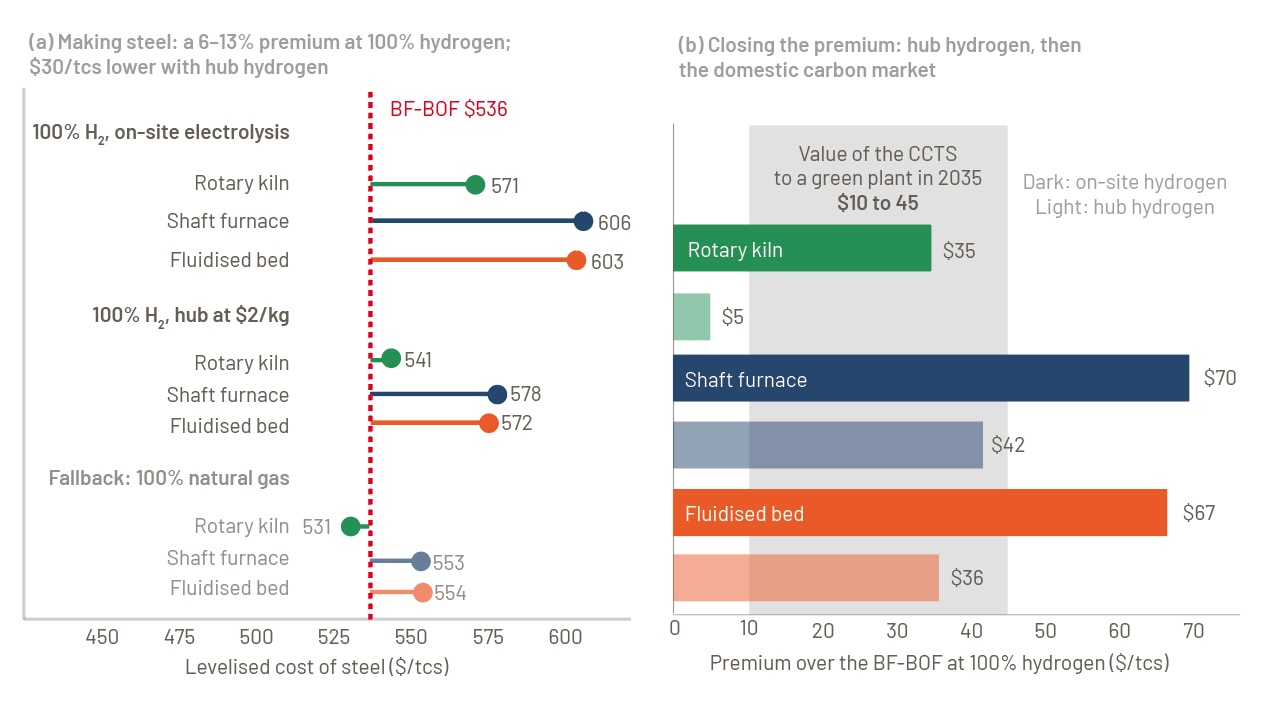
Figure 1 The report in one picture. (a) the levelised cost of making steel for each configuration, with natural gas shown as the fallback. (b) the premium of each route at 100% hydrogen, on on-site and on hub hydrogen, against the value of the CCTS to a green plant in 2035.
Power and Hydrogen Procurement Matter More Than the Technology Choice
The report finds that how AM/NS procures its electricity and hydrogen moves the cost of steel several times more than the choice of DRI reactor.
The power contract alone is worth up to US$129-148 (₹11,200–12,900) per tonne. That value rests on two regulatory concessions whose continuation for a load of this size is not assured. One is the surcharge exemption for group-captive power (US$81–94, ₹7,100–8,200 per tonne). The other is energy banking with the state distribution utility (US$50–57, ₹4,400–5,000 per tonne). Both sit with the Andhra Pradesh Electricity Regulatory Commission and the Eastern Power Distribution Company of Andhra Pradesh: the state’s banking envelope is about 700 MW, while the project would need more than twice that at full scale. Of the power structures tested, only the case with both group-captive power and banking provides the project cash flows that lenders typically require.
Buying hydrogen from the green hydrogen hub that NTPC Green Energy is developing at Pudimadaka, some 40 km from the site, can be a larger lever. At a delivered price of US$2 (₹174) per kg of hydrogen, it is US$28-30 (₹2,400–2,600) per tonne of steel cheaper than making hydrogen onsite. It cuts US$1.2 billion (₹10,500 crore) of capital costs from the project’s balance sheet and lifts the debt-service coverage ratio from 1.65 times to 1.93 times. This would materially improve bankability at only a modest increase in production cost. With hub hydrogen, the rotary kiln route makes steel for US$541 (₹47,200) per tonne, within US$5 (₹400) of coal-based steel.
Carbon Pricing: India’s Market First, the EU Border Second
India’s Carbon Credit Trading Scheme (“CCTS” or “the scheme”), as currently drafted, sets reduction targets based on each plant’s individual baseline. Because new greenfield facilities enter without historical operating data, the scheme’s primary financial benefit to a green plant comes from the compliance costs it imposes on conventional, high-carbon competitors
- Moderate Scenario: At an indicative US$24 (₹2,100) per tonne of CO₂, with targets tightening 2% a year, that value is about US$10 (₹833) per tonne of steel by 2035.
- Ambitious Scenario: At US$50 (₹4,400), with targets tightening 5% a year, it is US$45 (₹3,900). That is enough to close the rotary kiln’s premium as Phase 2 commissions.
However, the current design offers a greenfield green plant limited direct rewards. However, if the scheme evolves towards a common emission-intensity threshold, with credits for plants below it, a carbon price of US$25–50 (₹2,200–4,400) would cover the whole premium.
The EU’s carbon border adjustment makes hydrogen-based steel US$179–209 (₹15,600–18,200) per tonne cheaper to land in Europe than Indian coal-based steel in 2033. India exports only 3–5% of its steel, so this supports the investment case but does not carry it. One risk stands out. If Phase 2 is reported to the EU as one installation with Phase 1, its 2034 border charge rises from about US$27 to US$155 (₹2,400 to ₹13,500) per tonne. Reporting Phase 2 as a separate installation from the outset avoids this at no cost.
What Happens Next
The report concludes that Phase 2’s outcome rests less on engineering than on a small number of decisions that are still open.
- AM/NS India can commit to a fuel-flexible reactor designed for hydrogen from the start, and secure its power and hydrogen contracts well ahead of a final investment decision.
- Indian policymakers can publish a long-dated path for CCTS reduction targets, and signal early how the scheme will treat low-emission capacity. They can turn the Green Steel Taxonomy into demand, expand the energy-banking envelope or support storage, and deliver the hydrogen hub near US$2 per kg.
- Lenders can look past headline production costs to the coverage and cash-flow metrics that will determine whether the plant gets built.
Alastair Jackson, Head of Research at Transition Asia commented,
“Steel production powered by hydrogen is no longer a far-off goal, it is rapidly approaching economic competitiveness. Given mature technological pathways, access to high-grade ore slurries, and nearby hydrogen infrastructure, the primary question for Phase 2 of the Rajayyapeta project is no longer whether green steel facilities can be constructed. Instead, it is whether key enabling conditions, including power, hydrogen, and carbon policy, can be established quickly enough to realise this green industrial opportunity.
Beyond these factors, key concerns remain centered on the dependence on international energy markets. The recent LNG supply shocks underline the need to build resource security straight into Phase 2. Plants built to rely on fuel imports are inherently exposed to associated supply disruptions and price spikes. By designing Phase 2 for resilience from the start and championing favorable policy conditions, AM/NS India has a distinct chance to reinforce its position in the nation’s emerging green steel market.
Mr Girish Sethi, Senior Director, at The Energy and Resources Institute commented,
“Green steel is not only a technical challenge, but also a commercial one. Companies will naturally look for projects that can deliver viable returns, and many of the emerging green hydrogen projects in Andhra Pradesh are closely linked to export markets. We are currently facing a ‘chicken and egg’ challenge: green hydrogen may be available, but at a higher cost, while buyers are not yet willing to pay that premium. This creates a difficult situation for producers, who need demand and investment to bring costs down, while buyers are waiting for costs to become more competitive. Addressing this gap will be critical to accelerating India’s green steel transition.”
For enquiries, please contact:
Monica Wong – Communications Specialist | monica@transitionasia.org