

How Carbon Markets Can Increase the Share of Electric Arc Furnace Steel in China
Insights from the EU ETS Reform for Expanding China’s National Carbon Market to the Industrial Sector
Summary
- While bringing new technologies into the allocation system, the EU has maintained free allocation of allowances for the sector as a whole. Meanwhile, it preserves a continuous economic incentive for low-carbon technology in place.
- The EU ETS’s inclusion of indirect emissions into actual allocation of allowances for EAF carbon steel and EAF high alloy steel in the 2026-2030 period allow EAF producers to receive a larger volume of free allowances.
- In the 2026-2030 period, the EU ETS will bring for the first time products in the value chain, such as pellets used for DRI, into the previous sintered ore benchmark, now renamed as agglomerated ore, improving the adaptability of EU ETS to less carbon intensive steelmaking routes.
- Similarly, the EU ETS’s new inclusion of DRI into the hot metal benchmark, while keeping the benchmark from a sharp drop, encourages companies to switch from conventional BF to DRI.
- For China, directly adopting the EU ETS approach is unlikely to be appropriate, given differences in development stages and policy objectives.
- The design of China’s ETS for steel sector companies should ensure that companies adopting low carbon routes can receive incentives that match their contribution to emissions reduction.
- For China, closer coordination between the carbon market and related industrial, energy and circular economy policies is needed to maximise the effectiveness of the ETS.
In 2025, China officially extended its national carbon Emissions Trading Scheme (“China’s ETS”) to cover the steel sector, marking a significant milestone in the expansion of the scheme’s sectoral coverage. Electric arc furnace (EAF) steelmaking, however, remains outside the allowance allocation framework. As a result, its lower-carbon attributes are not yet rewarded in the carbon market, limiting the scheme’s ability to accelerate EAF deployment as part of the steel sector’s transition.
In 2022, China set the target to raise the share of EAF to 15% of crude steel output by 2025. However, the share remains around 10%, leaving a significant gap to the target.1 2 Beyond constraints such as scrap availability and affordability as well as electricity prices, EAF output growth is further constrained by the lack of market-based incentives to recognise the low-carbon value.
Internationally, the EU Emissions Trading System (“EU ETS”) provides a long-term and consistent policy signal for investment in lower-carbon steelmaking routes by covering EAF steel. However, due to the fact that China and the EU have differences in ETS design, market maturity and policy objectives, it would be naive to copy the EU approach directly. Therefore, further research is needed to explore how China’s ETS can be designed to recognise the emission difference in steelmaking routes while providing effective incentives for the uptake of EAF.
This blog examines the EU ETS allocation mechanism for the steel sector, assesses options for incorporating EAF steelmaking into China’s ETS, and offers reference points for refining ETS policy to support low-carbon steelmaking in China.
1. Overview of the EU ETS
The EU ETS is based on Cap and Trade principle, which sets an overall ceiling on greenhouse gas (GHG) emissions from the power, manufacturing, aviation and maritime sectors. The cap equals the total allowances issued, with each allowance corresponding to one tonne of CO2-equivalent emission. The core objectives are to cut emissions and finance the clean energy transition. To fulfill the emission reduction goal, the annual allowance supply is tied to the EU’s climate targets and declines annually. Following the 2023 revision, the cap is set to bring emissions down by 62% by 2030 compared to 2005 levels. And the reduction factor has been increased from 2.2% per year starting in 2021 to 4.3% per year over the period of 2024-2027 and 4.4% per year from 2028.3 A one-off reduction of 90 million allowances was implemented in 2024 and another cap reduction of 27 million allowances is scheduled in 2026.4
Allowances are mainly obtained through auctions hosted by member states, with the exception that the steel sector continues to receive free allowances allocation until 2030. However it doesn’t mean steelmakers don’t need to buy allowances. The number of allowances each steelmaker receives depends on their own historical emissions along with product benchmarks set in the ETS policy. Benchmarks are further decided by the average value of the 10% most efficient installations across the EU. A company whose free allowances exceeds its actual emissions are allowed to sell any remaining allowances to the market. Conversely, a company whose free allowances fall short of its actual emissions must purchase additional allowances and will face significant penalties if the gap is not filled.
2. How the EU ETS Design Encourages Lower-Carbon Processes
EAF steelmaking is less emissions-intensive than BF-BOF production. On that premises, the sector-wide emissions cap creates incentives for producers to shift towards EAF steelmaking. In other words, under a binding emissions cap, the lower emissions intensity of the EAF route translates into a relative compliance cost advantage over BF-BOF, providing an incentive for EAF deployment.
The existing free allocation of allowances partially weakens that incentive but the design of the framework still offers room to encourage greater deployment of EAF steelmaking. During the 2021-2025 period, the EU set three benchmarks for BF-BOF steelmaking routes, which are, coke, sintered ore and hot metal, as well as EAF carbon steel and EAF high-alloy steel for EAF steelmaking routes. Different steelmaking routes are competing within its own product benchmark which is anchored to its top 10% performers. In practice, this means free allocation over 2021-2025 mainly rewarded efficiency gains within each process route, rather than driving a shift from BF-BOF to EAF. In the future, when efficiency improvement only has marginal gain, deeper emissions cuts will increasingly require a shift in production routes. To genuinely favor those lower-carbon routes, a differentiation among the product benchmarks themselves is required. The EU’s recent update to the 2026-2030 benchmarks reflect precisely this approach.
Table 1. EU ETS steel sector benchmarks, 2021-2025
| Product benchmark | Average value of the 10 % most efficient installations in 2016 and 2017 (t CO2 equivalents/t) | Benchmark value (allowances/t) for 2021-2025 |
| Coke | 0.144 | 0.217 |
| Sintered ore | 0.163 | 0.157 |
| Hot metal | 1.331 | 1.288 |
| EAF carbon steel | 0.209 | 0.215 |
| EAF high alloy steel | 0.266 | 0.268 |
Source:https://eur-lex.europa.eu/eli/reg_impl/2021/447
2.1 How the Benchmark Update Encourages EAF Steelmaking
In June 2026, the European Commission released the benchmark for 2026-2030 free allocation, revising the allocation methodology associated with the product EAF carbon steel and EAF high-alloy steel. During 2021-2025, even if benchmarks took into account both direct and indirect emissions, the free allocation of allowances was based on direct emissions only. In the 2026-2030 revision, EU ETS factored in indirect emissions into the free allocation calculation and therefore, allowing EAF producers to receive a larger volume of free allowances.
During 2021-2025, the annual free allocation of allowances formula can be simplified as:

Since the product benchmark considers both direct and indirect emissions, according to this formula, only direct emissions are included in the final calculation of total free allocation of allowances. Over the 2026-2030, the exchangeability between fuel and electricity , i.e. the correction factor above, has been removed. Free allowances are then tied directly to the benchmark, with no adjustment for the direct/indirect split. The revised formula can be simplified as:

For electricity-intensive EAF steelmakers with a high share of indirect emissions, this change substantially raises the free allowances per tonne of product compared to the 2021-2025 period for the same level of activity. Thus, it provides a strong economic incentive for electrification across the sector. To be noted, the hot metal benchmark and its allocation are unaffected as the correction factor only applies to the EAF products but not BF-BOF related products.
2.2 How the Benchmark Update Promotes Direct Reduction
Sintered ore
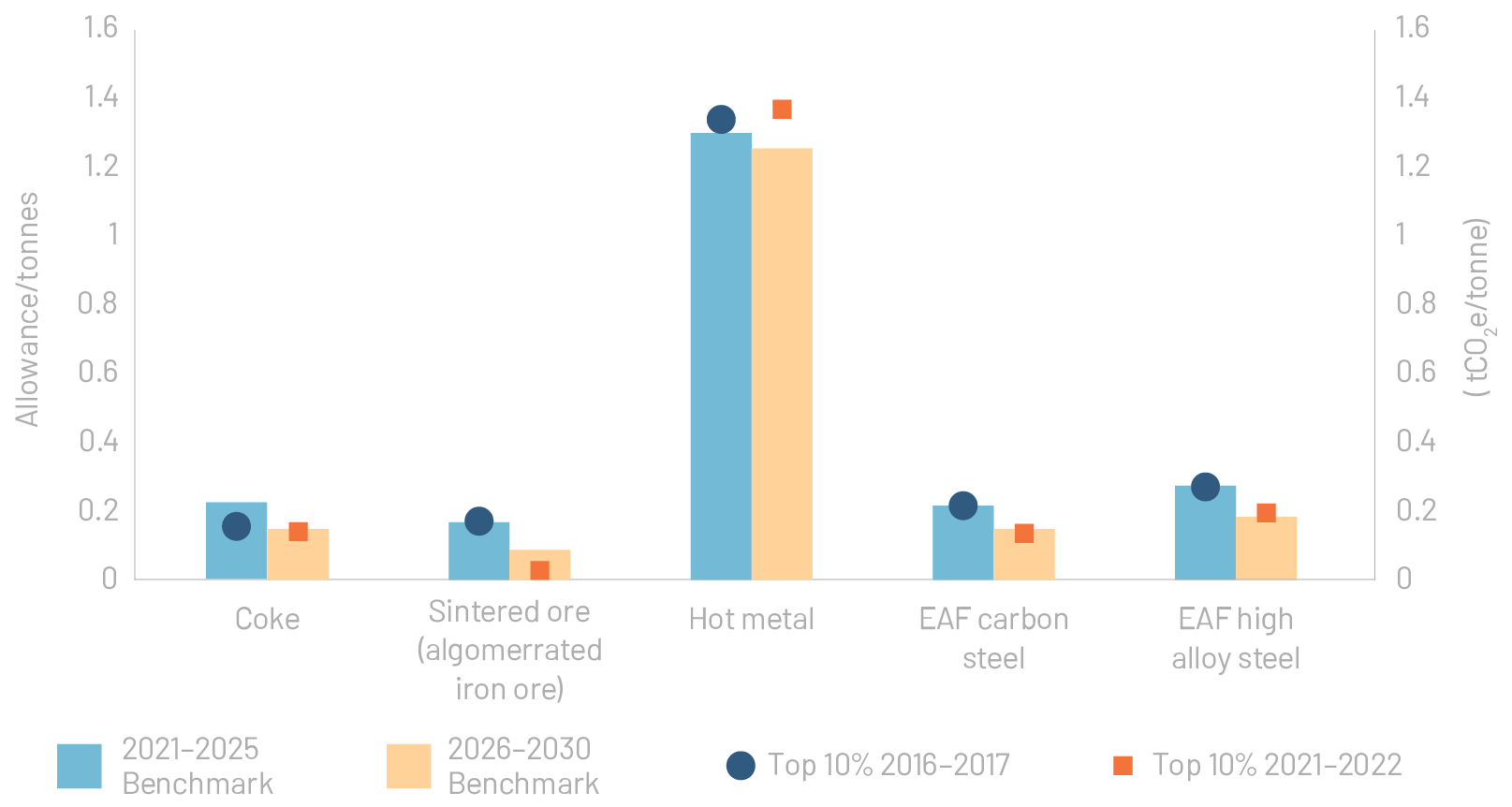
The benchmark for sintered ore shows a significant decline after the revision. This change does not reflect a substantial improvement in the GHG emissions of the top 10% of installations. Rather, it attributes to the revision of the product definition and system boundary, in which the benchmark is set to cover other agglomerated iron ore and renamed the product category as “agglomerated ore.” As a result, the 2026-2030 benchmark values are not directly comparable with those for 2021-2025.
This scope expansion means this product category no longer covers only conventional sintering, but also the pellets used in direct reduced iron (DRI) production. This revision change addresses a key limitation of the previous benchmark, which was designed around conventional blast-furnace products. By bringing in DRI related products within the same benchmark, it improves the adaptability of EU ETS to less carbon intensive steelmaking routes. Moreover, as pelletizing typically has lower GHG emissions than conventional sintering, and both now sit under the same benchmark, pellet producers will see a higher share of their emissions covered by free allowances and correspondingly stronger economic incentives.
Figure 1. EU ETS benchmarks versus average value of the 10 % most efficient installations, 2021-2025 vs. 2026-2030
Source: Eur-Lex portal, TA analysis
Hot metal
The revisions also reshapes the ironmaking benchmark so that DRI producers receive more free allowances thus rewarding the transition from BF-BOF to DRI. Plus considering that DRI is typically paired with an EAF, the change can also be read as the support for the DRI-EAF route.
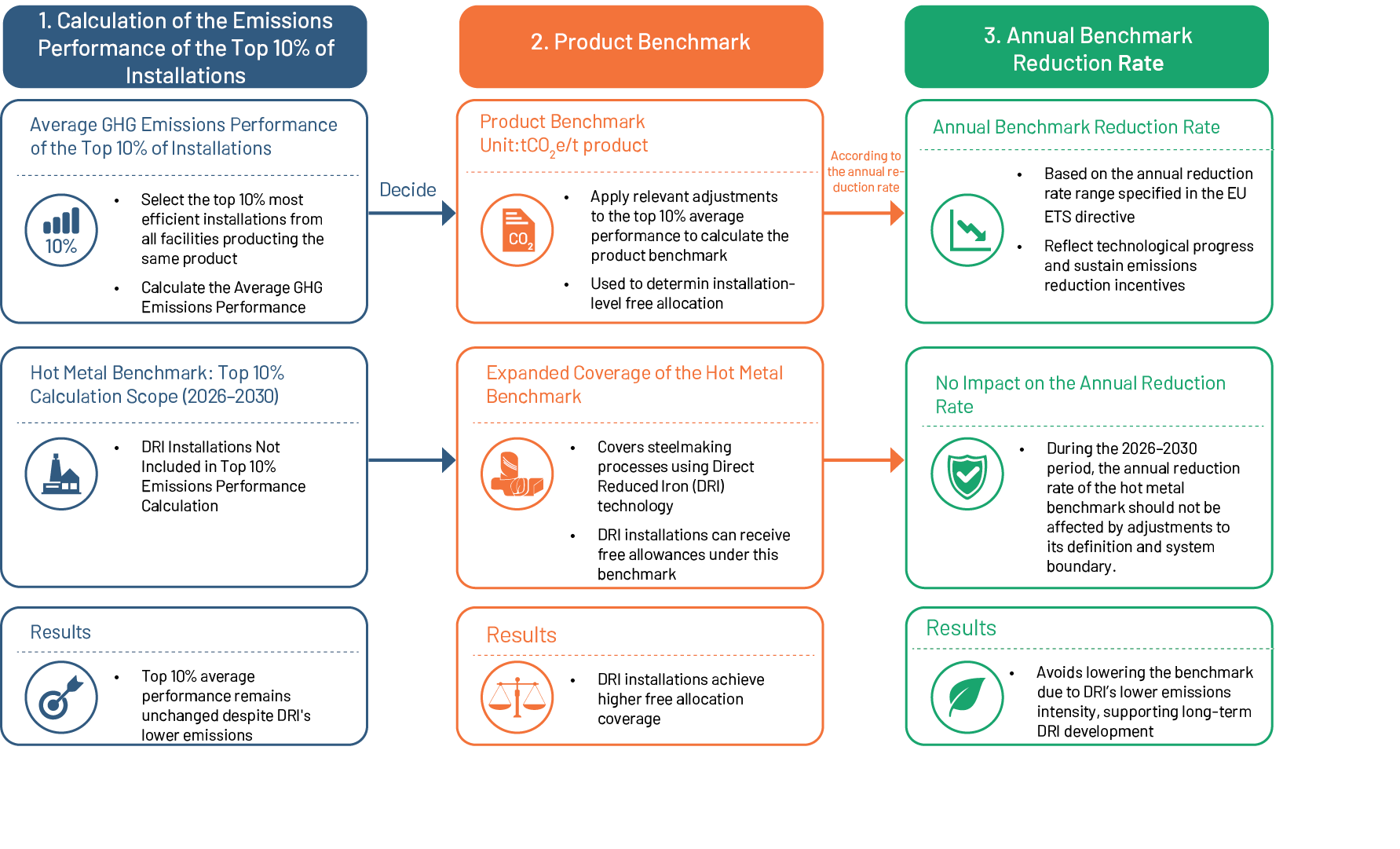
For 2026-2030, the hot metal product definition and system boundary have been expanded to cover DRI. Unlike sintered-ore benchmark, the hot metal benchmark does not decrease significantly as a result of this expanded scope. That is because, while DRI now sits within the hot metal product boundary, DRI installations are excluded from the sample used to calculate the average emissions intensity of the “top 10% most efficient installations.” Meanwhile, the benchmark’s annual reduction rate remains unchanged. Therefore, including DRI neither lowers the benchmark nor accelerates its annual rate of decline.
By bringing DRI within the hot metal benchmark’s scope, the revision allows DRI to receive free allowances for the first time. Previously, DRI products fell outside the hot metal benchmark. This means a company switching from a blast furnace to DRI could not receive free allowances at all, limiting the EU ETS’s ability to incentivise the adoption of this lower-carbon technology.
At the same time, because DRI installations are excluded from the calculation of the benchmark itself, their inclusion does not lower the benchmark value. Instead, DRI installations receive free allowances based on the same benchmark as blast-furnace hot metal. Since their actual emissions are significantly lower than those of blast-furnace hot metal, DRI installations receive a higher level of free allocation relative to their emissions and may even generate a surplus of allowances. This design substantially strengthens the economic incentive for companies to switch from conventional blast furnaces to lower-carbon ironmaking routes such as DRI.
Figure 2. EU ETS 2026-2030 update to the hot metal benchmark
3. Overview of China’s ETS
China’s ETS currently uses an emissions intensity-based approach rather than an absolute emissions cap and allocates allowances for free. For the steel sector, the scheme currently covers only the main emissions source at BF-BOF producers, direct CO2 emissions, and does not include indirect emissions. 2024 was the first year in which the steel sector started trials in the scheme. For this initial compliance period, free allocation was set equal to each company’s actual emissions, with compliance due by the end of 2025. From the 2025 and 2026 compliance years onward, allocation shifts to the intensity-based approach. Steel companies emitting more than 26,000 tonnes of CO2-equivalent per year fall within ETS scope. Importantly, the quantity of free allowances a company receives depends on its actual emissions and the emissions intensity of its key processes, ironmaking and sintering, with no allowances for the EAF route even if there is an EAF facility. An intensity-deviation coefficient measures how far each company’s key-process intensity sits from the industry benchmark, and caps the resulting surplus or shortfall at ±3%. This is a more conservative design than the EU ETS, reflecting the fact that 2024-2026 is the launch phase for carbon management in China’s steel sector. Unlike the EU’s emissions-reduction focus, the priority for this period is to build a solid measurement and reporting foundation, help companies become familiar with the market rules, strengthen oversight, and build capacity across all participants.5
4. Exploring EAF Inclusion in China’s ETS
Under China’s ETS, a company’s annual allowances received is driven mainly by three factors: its direct CO2 emissions, the emission intensity of its key processes (ironmaking and sintering), and how far that intensity deviates from the industry benchmark. Allocation is calculated at the level of the legal entity or integrated steel producer, and for an integrated company running both BF-BOF and EAF capacity, adding EAF capacity has little effect on any of these three variables. On one hand, the EAF process involves neither ironmaking nor sintering and does not add to pig iron output, so it leaves the key-process intensity calculation unchanged. More importantly, if a company replaces part of its BF-BOF capacity with EAF capacity, the direct CO₂ emissions used to calculate its allowance allocation will fall. As a result, its total allocation may decrease rather than increase, reducing the potential carbon-market benefits of switching production routes.
If China’s ETS is to cover EAF steel the way the EU ETS does, it cannot simply imitate the EU’s approach — the two schemes differ in design and policy objectives. Even so, the EU’s ongoing fine-tuning of its benchmarks and free-allocation rules still provide useful insights. While bringing new technologies into the allocation system, the EU has avoided disrupting free allocation of allowances for the sector as a whole while still keeping a continuous economic incentive for low-carbon technology in place.
Within China’s existing ETS framework, if keeping the underlying free-allocation approach, could a targeted adjustment to the calculation method alone create an incentive for EAF production? The answer is affirmative. In the current allocation system, a key metric used to set a steel company’s intensity coefficient is the emissions-intensity deviation (X), calculated as:
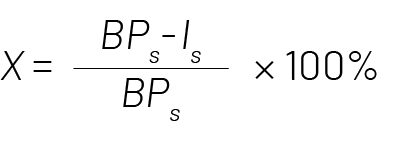
Where: X = the steel company’s emissions-intensity deviation, %
BPs = the 2025 industry balance value — the key-process (ironmaking and sintering) emissions intensity at which the sector’s total allocation equals total allowances surrendered, tCO2e/t
Pig iron Is = the ratio of the company’s key-process (ironmaking and sintering) emissions to its pig iron output, based on the year’s verified data, tCO2e/t pig iron
The key variable in this formula is Is — the ratio of total key-process emissions (Ei + Es) to pig iron output (Qi):
Where:
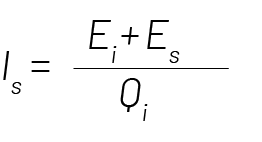
Ei = the company’s ironmaking-process emissions, based on the year’s verified data, tCO2e
Es = the company’s sintering-process emissions, based on the year’s verified data, tCO2e
Qi = the company’s pig iron output, based on the year’s verified data, t
Redefining the denominator in Is from pig iron output (Qi) as total crude steel output changes the picture. For an integrated steelmaker running both EAF and BF-BOF capacity, EAF output would now count in the denominator, while the numerator still reflects only direct ironmaking and sintering emissions. If a company adds EAF capacity, its Ei + Es remains unchanged while total crude steel output increases, resulting in a lower Is. If a company replaces existing BF-BOF capacity with EAF capacity, Ei + Es will fall further as part of the blast-furnace ironmaking and sintering processes is replaced by scrap-based EAF or DRI production, while crude steel output remains broadly unchanged. It will therefore also decline.
Figure 3. Exploring Scenarios for Including EAF Steelmaking in China’s ETS – Integrated Steel Producers
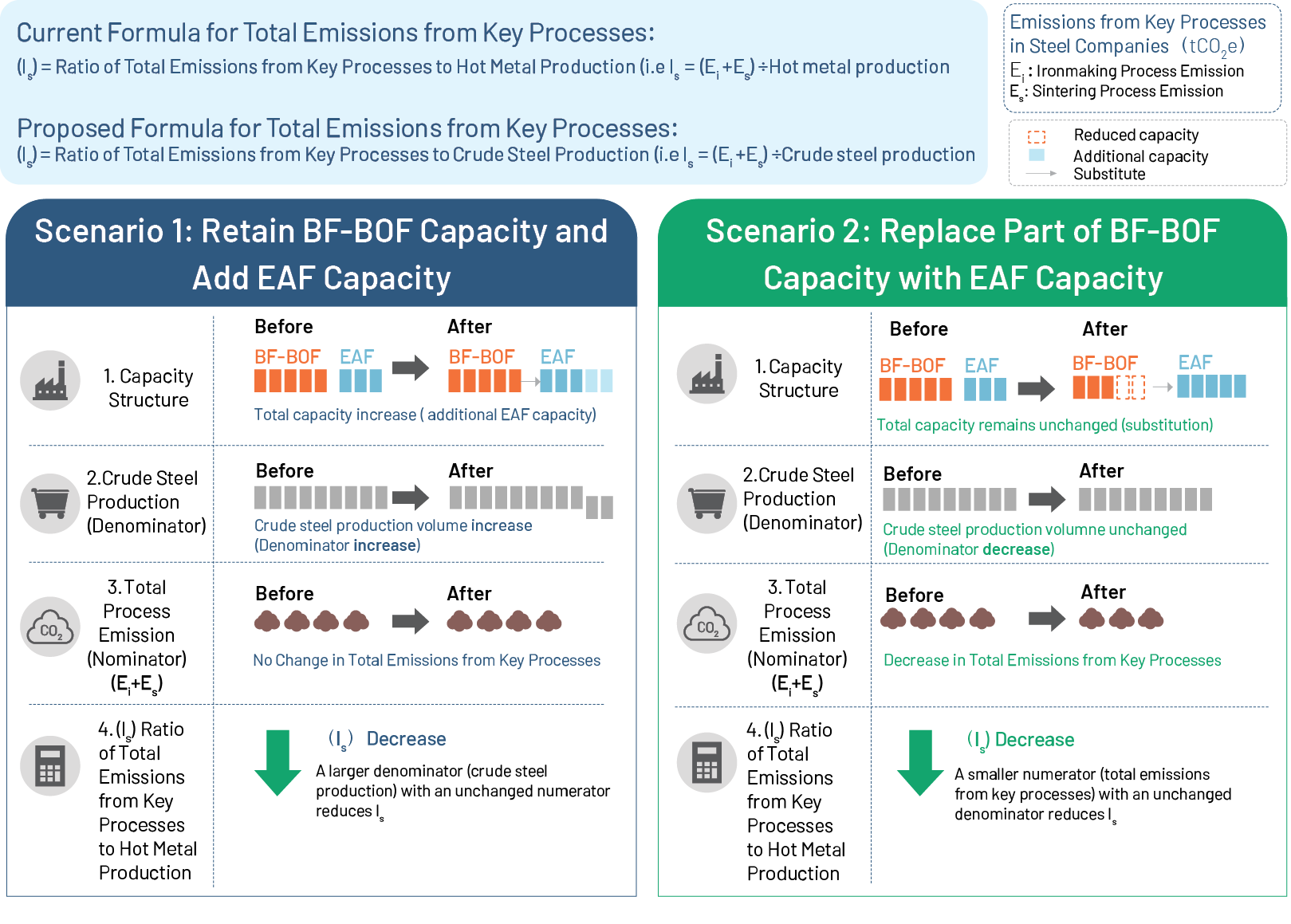
Under the current allocation rules, the sector balance value (BPs) is fixed for all steel companies within a given compliance year. All else being equal, integrated steel companies with a higher share of EAF crude steel production have a lower Is and therefore a larger positive deviation from the sector balance value, allowing them to receive more free allowances.
In this context, the meaning of Is shifts from “sintering and ironmaking emissions per unit of pig iron” to “sintering and ironmaking emissions per unit of crude steel”. Optimising the production mix – by increasing the share of EAF steel in crude steel production and reducing reliance on the BF-BOF route – would therefore be directly reflected in allowance allocation outcomes. This would provide an economic incentive for the steel industry to shift towards lower-carbon steelmaking routes, including scrap-based EAF and DRI-EAF production.
Nevertheless the above assumption has some limitations. First, if a company adds only a small amount of EAF capacity while leaving its BF-BOF capacity largely unchanged, it could receive more free allowances as a result of higher crude steel production and increase the total sectoral emission. The proposal should therefore be implemented alongside strict policies on capacity replacement and crude steel production control policies to ensure that the allocation incentive primarily supports a shift in production routes rather than an expansion of crude steel output.
Second, the analysis above applies mainly to integrated companies that run both BF-BOF and EAF capacity. If China’s ETS were to expand its coverage to include standalone EAF producers but don’t want a wholesale redesign, one option would be to keep crude steel output as the denominator in Is, while expanding the numerator to include the key-process emissions specific to each steelmaking route, for example:
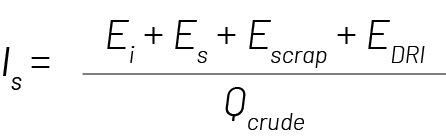
Under this framework, different production routes, including standalone scrap-based EAFs, natural gas-based EAFs and hydrogen-based EAFs, can be assessed within a common carbon-intensity framework based on their respective process emissions. This would enable allowance allocation to more accurately reflect the actual emissions reductions achieved by different production routes.
This proposal remains exploratory, and the emissions boundaries for different ironmaking feedstocks, which determine the numerator of the calculation, require further clarification, particularly for DRI. DRI can be produced using coal, natural gas or hydrogen as the reducing agent, with significantly different emissions intensities. It also remains necessary to clarify how emissions associated with externally sourced DRI should be accounted for.
If China’s ETS were instead to move from an intensity-based approach to an EU-style absolute cap with no free allocation, the incentive structure would change fundamentally. The whole steel sector would face a shared, progressively tightening emissions cap. Under that model, a lower-emitting producer needs fewer allowances per tonne of output, carries a lower carbon cost, and gains a real cost advantage over higher-emitting BF-BOF producers.
5.Conclusion
Through a series of changes to product definitions, system boundaries, calculation methods and free-allocation rules for 2026-2030, the EU has strengthened the economic case for lower-carbon steelmaking. Removing the exchangeability between fuel and electricity from the EAF benchmarks means EAF producers are no longer penalised in free allocation. Bringing DRI within the scope of the hot metal benchmark while excluding DRI installations from the benchmark calculation sample allows DRI producers to receive free allowances without lowering the benchmark. Similarly, folding pellets and other agglomerated ore products into the sintered-ore benchmark closes a gap in a framework originally built around conventional blast-furnace products, making the EU ETS more relevant to emerging low-carbon ironmaking. The broader lesson here is less about the specific rules than about the approach: achieving a policy goal by refining the details of an existing system, without overhauling the free-allocation method itself.
For China, directly adopting the EU ETS approach is unlikely to be appropriate, given differences in development stages and policy objectives. Within China’s existing intensity-based system, a targeted adjustment is possible. For example, replacing pig iron output with crude steel output in the intensity-deviation calculation would translate an integrated producer’s higher EAF output directly into a visible economic incentive. For standalone EAF producers, the numerator could be extended to capture the key-process emissions of different technology routes, allowing them to be measured within the same intensity framework. However, this approach should be treated with caution, the emissions boundary still needs further clarification, particularly regarding the difference in emissions among DRI routes using different feedstocks, and how to attribute emissions from purchased DRI.
Whichever path is taken, the design of China’s ETS for the steel sector should not focus solely on whether EAF steel is brought within scope of the scheme. Rather, it should ensure that the country’s “dual carbon” goals are translated into meaningful support for different low-carbon technology routes, so that companies adopting low carbon routes can receive incentives that match their contribution to emissions reduction. At the same time, closer coordination between the carbon market and related industrial, energy and circular economy policies is needed to maximise the effectiveness of the policy mix and support the green and low-carbon transition of the steel sector.
Footnote
- https://www.mee.gov.cn/xxgk2018/xxgk/xxgk10/202202/t20220208_968879.html
- https://worldsteel.org/wp-content/uploads/WSIF-2025_CN-4.pdf
- In July 2026, the European Commission proposed to revise the reduction factor to 3.7% for the period 2031-35 and of 1.7% from 2036 onward. This is consistent with the EU’s 2040 target of a 90% net GHG emissions reduction. Please note that this is only a proposal and still needs to be agreed through the legislative procedure. EU leaders aim to reach agreement by the end of Q1 2027.
- https://climate.ec.europa.eu/eu-action/carbon-markets/eu-emissions-trading-system-eu-ets/eu-ets-emissions-cap_en?prefLang=lt
- https://www.mee.gov.cn/ywdt/zbft/202503/t20250326_1104767.shtml
Author

Research Analyst