

The Mass Balance Approach in Aluminium
Insights from Steel Industry Applications for the Aluminium Sector
Achieving global agreement on how to define low carbon products like steel and aluminium remains a key challenge in advancing decarbonisation efforts. In the steel industry, the mass balance approach has long been a subject of debate. One variation, adopted in Japan allocates Reduced Emissions of Product (REP)1 across different time periods and production lines to specific products, i.e., an inter-site allocation approach. This has reignited concerns over the transparency of environmental data.
Lead the Charge, a global network of climate, human rights and advocacy groups monitoring automakers’ progress on socio-environmental issues, highlighted the mass balance approach in its 2026 Leaderboard Findings. The report introduced updated definitions for “fossil-free steel/aluminium” and “lower emission steel/aluminium”. As a result, Nissan’s score was downgraded following its use of the mass balance approach in its offtake agreement for “green steel”. Through case studies, the report further underscored the potential issues associated with the steel industry’s use of the mass balance approach, bringing this long-standing debate back into focus.2 3
This raises several important questions: Why does the mass balance approach remain so controversial in the steel industry? How has it been received by the aluminium industry, and does it face similar greenwashing risks? If this method continues to face widespread skepticism, what should define truly “low-emission aluminium”?
A Ledger Game or True Traceability?
To address these questions, we must begin with the definition of the mass balance approach and how it applies to steel and aluminium. The mass balance approach is one of the Chain of Custody (CoC) models. Like other CoC models, it enables traceability of materials from source to final product through a combination of procedures, technical systems, and documented records. The key distinction between these models lies in how materials are tracked—specifically, whether mixing is permitted and whether material attributes can be decoupled from their physical flows. The four main Chain of Custody models operate as follows:4
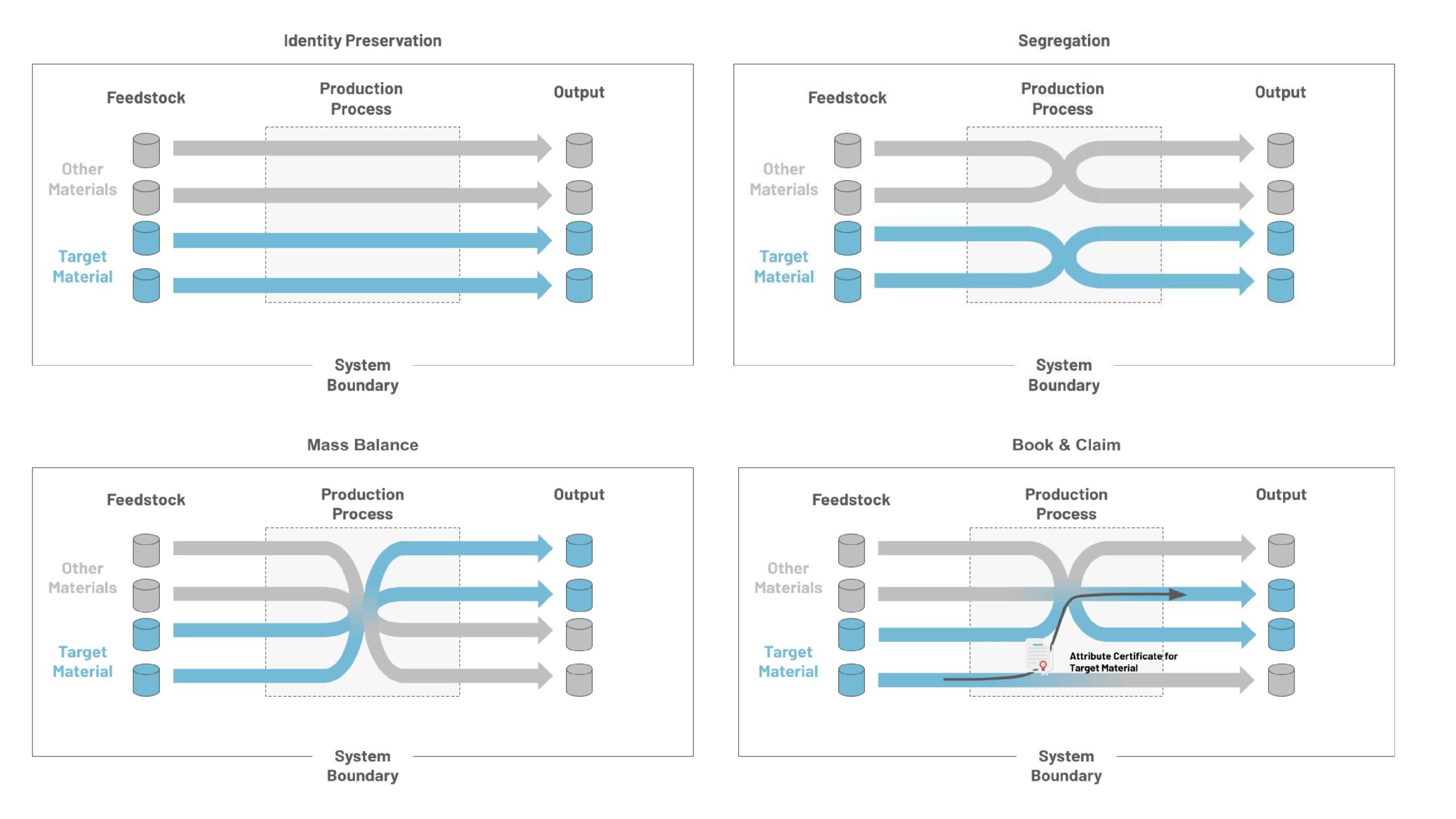
Source: TA, based on data from Circularise
All four models aim to ensure traceability of target materials within a relatively closed system, from input to final output. The first two models, Identity Preservation and Segregation, apply stricter requirements, prohibiting any physical mixing of target materials with other inputs. In cases where physical traceability or separation is not feasible, the latter two models are typically used. The mass balance approach allows different materials to be physically mixed, provided that the input of certified material is verified, accurately recorded, and tracked throughout the supply chain, and that its share in the final product is ultimately accounted for.5 By contrast, the Book & Claim model applies more flexible requirements. It allows specific attributes of target materials to be decoupled from their physical flows, with these attributes represented and transacted in the form of certificates within the system. The only requirement is that the volume of issued and claimed certificates corresponds to the total amount of the relevant attributes within the system. This model is currently widely used in renewable energy markets (e.g. renewable energy certificates) and carbon trading schemes. As it does not rely on physical traceability or geographic linkage, it offers greater operational flexibility, but also faces a higher risk of double counting.
Regardless of the model applied, maintaining clear system boundaries and ensuring a balance between total inputs and outputs are fundamental to upholding the principles of Chain of Custody.
The mass balance approach is mainly applied to raw materials and energy inputs, which is a common scenario in aluminium production. For example, the Aluminium Stewardship Initiative (ASI) uses the mass balance approach in its Chain of Custody (CoC) Standard. This allows certified entities to mix certified CoC and non-certified material within a defined claim period, and to calculate the corresponding output of CoC material (including any eligible scrap) based on the proportion of certified inputs.6 Under this system, ASI CoC certified entities must track CoC material inputs and outputs within their accounting systems to prevent over-allocation or double counting.7
In China, the mass balance approach in aluminium production primarily tracks and allocates the attribute of green electricity and recycled aluminium inputs. The China Green-Metal Certification Center (CGMC) has developed a green evaluation and traceability system for aluminium and aluminium alloy products. This system includes two key certifications: The first “Green Electricity Aluminium”, certifies the green attributes of primary aluminium (electrolytic aluminium liquid and remelting aluminium ingots). The assessment covers electrolytic aluminium production and rigorously verifies the actual use of green electricity and Renewable Energy Certificates (RECs). Based on this, green electricity aluminium quotas are calculated and issued according to usage volume and standardised AC power consumption per unit of output.8 The second, “Green Low-Carbon Aluminium”, is assessed based on raw material composition. Its system boundary is limited to the melting and casting stages of the production process, and it requires that non-green electricity aluminium account for no more than 30% of total inputs.9
Against this backdrop, Japan’s inter-site allocation approach for “green steel”, and the concerns surrounding it, become clearer. This approach allows steel companies to treat their entire enterprise as a single unit. It also extends the time dimension, enabling companies to allocate emission reductions from any carbon reduction project in the last 10 years to their current day steel products, in principle.10 Although this approach is labelled as “mass balance” in Japan, the cross-site allocation of emissions reductions does not, in essence, reflect the physical mixing and traceability that underpin the mass balance model. Instead, it more closely resembles an accounting-based allocation of attributes and may therefore be classified as a method distinct from the widely recognised mass balance model. This approach expands both the physical and temporal boundaries, blurring the clear system boundaries that should exist in the chain of custody model and creating scope for misleading claims. Low-carbon steel purchased by downstream users could, in theory, be high-emission products to which REP has been assigned. Within such broad boundaries, accurately tracing, calculating, and allocating REP from inputs to outputs becomes extremely difficult. This creates significant risk around double counting and greenwashing. More importantly, consumer purchasing behavior has not created a strong enough market signal to push steelmakers to invest in, deploy, and scale low-carbon production. As a result, consumer demand alone has not been sufficient to drive the industry’s low-carbon transition.
Behind the Debate: A Shared Commitment to Low-Carbon Transition
The examples above illustrate a key distinction: the mass balance approach sets different system boundaries and input parameters when evaluating low-carbon steel versus low-carbon aluminium. This difference directly shapes how the method is perceived by the international community.
In the steel sector, several leading international manufacturers have launched “low-carbon” and even “net zero” steel products using the inter-site allocation approach or similar frameworks.11 However, this method is facing increasing scrutiny, as it expands accounting boundaries, obscures the traceability of REP, and allows emissions reductions to be allocated across conventional products. Multiple organisations, including the Industrial Deep Decarbonisation Initiative (IDDI), the GHG Protocol, SBTi, and the World Steel Association are now actively debating the issue.12 Notably, SBTi states in its Corporate Net Zero Standard Version 2.0 draft that the environmental attributes should not be derived through cross-product averaging methods like a “carbon bank” model.13 This position strongly endorses the need for traceable and verifiable chain of custody models.
Unlike steel, the mass balance approach in aluminium, especially the ASI CoC standard, appears to be gradually gaining traction. From 2019 to 2023, entities worldwide with CoC certification that submitted material flow data grew from 13 to 79.14 During this period, primary aluminium and eligible scrap inputs meeting ASI standards increased 5-fold and 23-fold, respectively.15 In China, the high-quality LCA carbon footprint database for China’s aluminium industry, which underpins green electricity aluminium evaluation and green low-carbon aluminium certification, has received recognition from international institutions including the International Aluminium Institute, the ASI, and the London Metal Exchange. It has also been successfully featured on the UN Environment Programme’s Global LCA Data Access platform.16 The establishment and refinement of the database serves not only as a prerequisite for ensuring accurate traceability under the mass balance method, but also as a solid foundation for advancing future low-carbon aluminium product standards and achieving genuine physical integration of green electricity.
Beyond the definition of the CoC model, international standards also warrant close attention and learning. ISO 14044, the core LCA standard, states that allocation should be avoided where possible. Where it cannot be avoided, allocation should be based first on physical relationships, with economic allocation used only as a last resort.17 ISO 22095 also draws a clear line between mass balance (ISO 22095-2) and book-and-claim (ISO 22095-3), and specifies the standards and labelling requirements for each.18
This is more than a question of terminology. It has direct implications for the credibility of the low-carbon transition: whatever standards or accounting methods steel and aluminium products adopt, the key is ensuring that low-carbon attributes remain accurately linked to the product across complex production chains. Standards matter not because they attach a low-carbon label, but because they provide a traceable, verifiable basis of trust in the emissions reductions behind the claim. On the road to net zero, only approaches that withstand both policy and market scrutiny can credibly support the transition to low-carbon materials.
Reflections for the Aluminium Industry
In summary, the mass balance approach fundamentally operates through “allocation”. While this allocation mechanism can facilitate decarbonisation applications, it also entails inherent limitations, as it allows the mixing of low-carbon and conventional materials rather than relying on strict physical traceability. As a result, low-carbon attributes are assigned to specific products through allocation or accounting, enabling a form of virtual transfer of emissions reduction benefits.
While progress has been made, the aluminium industry remains at an early stage of its low-carbon transition. Green electricity and recycled aluminium have not yet been widely adopted across all stages of production, due to supply and cost constraints. In this context, the mass balance approach serves as an incentive and verification tool for the actual use of green electricity and recycled aluminium, making it a viable evaluation method during this transitional phase. However, applying this method requires adherence to the following principles:
- For carbon reduction accounting, establish clear system boundaries and ensure precise traceability of raw material inputs. This foundation maintains the rationality of the mass balance approach and prevents carbon reductions from being arbitrarily allocated or double-counted.
- For carbon reduction evaluation, the evaluation method should be clearly stated. If the mass balance approach is adopted, its calculation method must be further explained (such as the definition of system boundaries, the types and proportions of input raw materials, and the allocation logic of carbon reduction amounts) to ensure the transparency and traceability of the assessment process. Simultaneously, core carbon reduction information should be recorded and disclosed as completely as possible. This includes but is not limited to the source, usage amount or proportion of green electricity and recycled aluminium, product carbon emissions and emission intensity, evaluation procedures, and reference standards. Detailed information prevents greenwashing risks and strengthens trust between producers and green aluminium purchasers.
Finally, we propose the following calls to action for stakeholders in the aluminium sector:
- To policymakers: We support the development of a globally applicable green aluminium standard that covers a range of low-carbon production pathways and supports fair trade in green aluminium products. In the long term, such a standard will enhance transparency of aluminium products’ low-carbon attributes, establish a more rational mechanism for distributing green aluminium premiums, and invigorate the market.
- To aluminium product manufacturers: Plan early for low-carbon production system construction and enhanced low-carbon management capabilities, while closely monitoring domestic and international green aluminium policy developments. Actively develop green electricity and recycled aluminium supply chains, and establish robust record-keeping systems for raw material and energy inputs and outputs to respond effectively to evolving low-carbon accounting and disclosure requirements.
- To downstream buyers: We encourage companies to gain a deeper understanding of the underlying logic of the mass balance approach, to accurately assess and verify the true low-carbon attributes of the products they procure in light of their own climate goals, and to pay close attention to the recognition of such certifications in both domestic and international markets. This protects business interests and maintains order in the green aluminium market, promoting a fair and genuine green aluminium trade for a sustainable future.
In the global race toward deep industrial decarbonisation, the mass balance approach serves, to some extent, as a transitional solution for tracing the use of green electricity and recycled aluminium in the early stages of the aluminium industry’s low-carbon transition, but is not a credible solution when true low-carbon products are available. Its value lies not in greenwashing, but in creating a credible channel to transmit the low-carbon value of every kilowatt-hour of green electricity and every tonne of recycled aluminium, establishing a demand-driven green premium market during this transition period.
Maintaining clear boundaries, ensuring transparent traceability, and prioritising physical carbon reduction are the principles the aluminium industry must uphold when applying the mass balance approach. Only then can this “ledger” withstand scrutiny from markets and time.
For policymakers, producers, and downstream buyers, the real challenge is not whether to adopt the mass balance approach but how to ensure that genuine low-carbon efforts are transparent, recognised and rewarded. As green electricity becomes more widely available and recycled aluminium moves into the mainstream, current debates around this accounting approach will help lay the foundation for a fair, transparent, orderly, and prosperous international green aluminium market.
End Notes
-
The JISF guidelines define ‘Reduced Emissions of Product (REP)’ as product-level emissions reductions derived from corporate actions. Such reductions are pooled and allocated to products on an arbitrary basis in accordance with specified methodologies. REP reflects allocated emissions reductions rather than actual product-level emissions.https://www.jisf.or.jp/business/ondanka/kouken/greensteel/documents/GXSteelGuideline_v4.1.pdf
- https://leadthecharge.org/wp-content/uploads/2026/03/LTC-2026-Leaderboard_compressed.pdf
- https://leadthecharge.org/wp-content/uploads/2026/02/Lead-the-Charge-Auto-supply-chain-Leaderboard-methodology-2026-Edition.docx.pdf
- https://www.circularise.com/blogs/four-chain-of-custody-models-explained
- https://scholarship.law.columbia.edu/cgi/viewcontent.cgi?params=/context/sustainable_investment/article/1024/&path_info=ccsi_GHG_accounting_steel_aluminum___Reet_Chatterjee.pdf
- https://aluminium-stewardship.org/wp-content/uploads/2022/07/ASI-CoC-and-claims.pdf
- https://aluminium-stewardship.org/wp-content/uploads/2024/06/Chain-of-Custody-Standard-Key-Metrics-Calculation-Guide.pdf
- https://mp.weixin.qq.com/s/exaXP-gjRVirqrRPY4Wcxg
- http://www.cnmte.cn/uploads/20250616_080734_4203.pdf
- https://www.jisf.or.jp/business/ondanka/kouken/greensteel/documents/GXSteelGuideline_v4.1.pdf
- https://www.jisf.or.jp/en/activity/climate/documents/202502JISFs_Carbon_Neutrality_Action_Plan_final.pdf
- https://www.renewable-ei.org/en/activities/column/REupdate/20251023.php
- https://files.sciencebasedtargets.org/production/files/CNZS-V2-Second-Consultation-Draft.pdf
- https://aluminium-stewardship.org/drive-change/chain-of-custody-material-flows#what-it-means
- https://aluminium-stewardship.org/tracking-asi-certified-material-2023-data-highlights-and-reporting-insights
- http://cnmte.cn/?cn-n-d-3595.html
- https://www.iso.org/standard/38498.html
- https://www.iso.org/contents/news/2026/03/new-iso-standards-bring-clarity.html#:~:text=To%20address%20this%20challenge%2C%20ISO,entering%20and%20leaving%20the%20system
Author

China Engagement Lead